

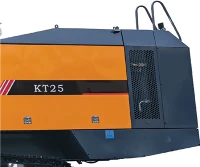


KT 7H Integrated Down The Hole Drill Rig For Open Use

KT 7H Integrated Down The Hole Drill Rig For Open Use suppliers

KT 7H Integrated Down The Hole Drill Rig For Open Use factory

KT 7H Integrated Down The Hole Drill Rig For Open Use best

KT 7H Integrated Down The Hole Drill Rig For Open Use high quality

KT 7H Integrated Down The Hole Drill Rig For Open Use price
KT 7H Integrated Down The Hole Drill Rig For Open Use
Jining Dongtai Lite Engineering Machinery Co., Ltd. is one of the leading manufacturers and suppliers of kt 7h integrated down the hole drill rig for open use in China. With abundant experience, we warmly welcome you to buy customized kt 7h integrated down the hole drill rig for open use made in China here from our factory. Good service and quality products are available.
Product Overview
The KT 7H Integrated Down The Hole Drill Rig For Open Use stands at the absolute pinnacle of our integrated drilling lineup: the most powerful, most fully equipped, and most capable self-contained DTH drill rig we manufacture. Combining the KT 7 series' ultra-high-capacity dual-engine platform with a fully enclosed ROPS/FOPS certified operator cabin, the most advanced intelligent drilling control system in the series, and the highest compressor output available in any integrated machine, the KT 7H is the definitive answer for operations that demand large-rig performance, world-class operator protection, and complete operational independence in a single crawler-mounted machine.
Where the KT 7C delivers the same drilling power in an open-station configuration for cost-sensitive applications, the KT 7H adds the enclosed climate-controlled cabin, enhanced dual-axis anti-deviation control, an upgraded satellite-primary remote monitoring system, and an extended intelligent drilling parameter library that allows the machine to be pre-programmed for complex multi-layer geological profiles before the shift begins. The result is a machine that not only drills harder and deeper than any other integrated rig in our range, but does so with the highest level of operator welfare, data capture, and autonomous drilling intelligence available in the integrated DTH category.
For tier-one mining companies, major EPC contractors, and drilling fleet operators who accept no compromise between performance, safety, and operational intelligence, the KT 7H represents the complete package: the most capable integrated DTH drill rig available for open-pit and quarry applications worldwide.
Key Features & Technical Advantages
Maximum-Output Dual-Engine Platform
- Dedicated high-output compressor engine (178 kW) driving the largest integrated compressor unit in the series, delivering 30 to 50 m3/min of free air delivery at working pressures up to 40 bar - sufficient to power 7-inch to 9-inch DTH hammers at full rated performance with no external air supply equipment.
- Independent primary drilling engine (132 kW) driving all hydraulic systems exclusively, with no power shared with the compressor at any point in the operating cycle, ensuring full compressor output is maintained during simultaneous tramming, mast positioning, and rod handling operations.
- Total installed power of 310 kW, providing the combined output required to sustain large-diameter DTH drilling at full production rates across extended multi-shift operations in the most demanding geological conditions.
- Independent engine management with cross-monitoring: each engine's health parameters are monitored by the central control system, with automatic alerts and protective shutdown sequences if either engine approaches operating limits, preventing damage during unattended or high-load operation.
Premium Enclosed Operator Cabin
- ROPS/FOPS certified enclosed cabin with full structural certification to international mining and construction equipment safety standards, providing roll-over and falling-object protection across all operating conditions.
- Dual-zone air conditioning and heating system with independent temperature control for the upper and lower cabin zones, maintaining optimal operator comfort across the full range of ambient conditions from desert heat to cold-climate winter operations.
- Enhanced acoustic insulation package reducing in-cabin noise levels to below 75 dB(A), the lowest in the integrated series, eliminating mandatory hearing protection requirements inside the cab and enabling clear voice communication between the operator and ground crew.
- Positive-pressure multi-stage filtered air supply with a HEPA-grade final filter stage, providing the highest level of in-cabin dust protection in the series and meeting the most stringent occupational exposure limits for respirable crystalline silica (RCS) in all major regulatory frameworks.
- Wide-format touchscreen instrument panel integrated into the cabin console, displaying all drilling, compressor, and engine parameters on a single high-resolution screen with configurable dashboard layouts, replacing the conventional gauge-and-lever interface with a modern human-machine interface (HMI) designed for intuitive single-operator use.
Advanced Intelligent Drilling System
- Extended multi-layer programmable drilling control: supports pre-programming of up to 10 distinct geological layer profiles per hole, each with independent feed force, rotation speed, penetration rate, and compressor pressure targets, enabling fully automated parameter management across complex multi-formation hole profiles without operator intervention.
- Dual-axis anti-deviation system: monitors drill string lateral load and mast inclination in two independent axes simultaneously, providing earlier deviation detection and more precise corrective response than single-axis systems, maintaining hole straightness to tighter tolerances across the full 48 m depth range.
- Automatic anti-jamming system with adaptive torque threshold learning: the system continuously refines its jamming detection threshold based on the actual torque signature of the current formation, reducing false-positive interventions in variable rock and improving response speed in genuinely jamming conditions.
- Comprehensive hole-by-hole data logging: records 12 drilling and machine parameters at 0.1 m depth intervals for every hole, generating a complete formation log alongside the production record, with data stored on an on-board SSD and automatically synchronized to the cloud dashboard via the remote monitoring module.
Satellite-Primary Fleet Management
- Satellite-primary remote monitoring module (standard): uses satellite as the primary communication link with cellular as automatic fallback, ensuring continuous data transmission regardless of site location, eliminating the connectivity gaps that affect cellular-only systems on remote mining sites.
- Cloud-based project dashboard: provides the project management team with real-time visibility of hole count, daily meterage, penetration rate trends, fuel consumption, machine health status, and GPS position for every KT 7H in the fleet, accessible from any device via web browser or mobile app.
- Predictive maintenance alerts: the remote monitoring system analyzes engine and compressor parameter trends to identify developing faults before they cause unplanned downtime, generating maintenance work orders automatically when parameters approach service thresholds.
Large-Rig Drilling Performance
- Drill hole diameter range: 165 mm to 229 mm, covering the large blast-hole specifications used in high-bench open-pit mining and high-production quarry operations.
- Maximum drilling depth: up to 48 m per setup, suitable for the deepest bench configurations in large-scale open-pit blasting programs.
- Ultra-high-torque rotary head: 5,000 N.m maximum output torque for large-diameter drill string management in the hardest rock formations at depth.
- High-capacity hydraulic feed system: 65 kN maximum feed force and 72 kN pull-back for precise bit-to-rock contact pressure control across the full depth range in rock up to 400 MPa UCS.
- Heavy-duty reinforced crawler undercarriage with extra-wide gauge steel tracks, hydraulic track tensioning, and automatic ground pressure equalization, engineered for the KT 7H's operating weight and the stability demands of large-diameter drilling on steep bench faces.


Technical Specifications

Typical Applications
- Tier-one large-scale open-pit mining: high-bench blast-hole drilling at major iron ore, copper, gold, and coal operations where the highest standards of operator welfare, drilling intelligence, and fleet management are required alongside maximum integrated drilling capacity.
- High-production quarrying with strict HSE compliance: large-diameter production drilling at operations subject to the most stringent national mining safety codes, where enclosed ROPS/FOPS cabin certification, RCS dust exposure compliance, and noise level limits are all mandatory.
- Extreme-climate large-output sites: operations in desert heat, tropical humidity, or cold-climate winter conditions where dual-zone climate control and HEPA-grade cabin filtration are essential for sustained operator performance across long shifts.
- Complex multi-geology drilling programs: sites where the geological profile varies significantly across the array footprint or within individual holes, requiring the KT 7H's 10-layer programmable drilling control to maintain optimal performance and tooling protection across all formation transitions.
- Remote mega-project fleet deployments: large multi-rig drilling campaigns in locations without reliable cellular coverage, where satellite-primary remote monitoring and predictive maintenance alerts are essential for fleet productivity management and unplanned downtime prevention.
- Pre-split and precision wall control drilling: large-diameter angle drilling for final pit wall control in major open-pit mines, where the dual-axis anti-deviation system's tighter hole straightness tolerances directly improve blast fragmentation uniformity and wall stability.
Frequently Asked Questions
Q: How does the KT 7H differ from the KT 7D, and when does the premium model justify the investment?
A: The KT 7D and KT 7H share the same dual-engine platform, compressor specification, hole diameter range, depth capability, and core drilling performance. The KT 7H adds five meaningful upgrades over the KT 7D: a dual-zone climate control cabin with enhanced acoustic insulation (below 75 dB(A) vs. below 80 dB(A)) and HEPA-grade cabin filtration; a wide-format touchscreen HMI replacing the conventional instrument panel; up to 10 programmable geological layer profiles per hole vs. the KT 7D's multi-layer system; a dual-axis anti-deviation system vs. single-axis; adaptive threshold anti-jamming vs. fixed threshold; 12-parameter data logging at 0.1 m resolution vs. standard parameters; and satellite-primary remote monitoring with predictive maintenance alerts. The KT 7H justifies the investment when any of these upgrades directly addresses a project requirement: strict RCS compliance, complex multi-layer geology, remote site connectivity, or predictive maintenance capability for a large fleet.
Q: What does the dual-axis anti-deviation system provide that single-axis does not?
A: A single-axis anti-deviation system monitors drill string lateral load in one plane, detecting deviation in the direction the sensor is oriented. A dual-axis system monitors two perpendicular planes simultaneously, detecting deviation in any direction regardless of the drill string's rotational position. In practice, this means the KT 7H detects the onset of hole deviation earlier, responds more precisely, and maintains tighter hole straightness tolerances across the full depth range. On large-diameter, deep-hole applications where hole straightness directly affects blast pattern accuracy, fragmentation uniformity, and pit wall stability, the dual-axis system provides a measurable improvement in hole quality consistency compared to single-axis designs.
Q: How does the 10-layer programmable drilling control work in practice?
A: Before the shift begins, the operator or drill-and-blast engineer loads the geological profile for the drilling zone into the KT 7H's control system, defining up to 10 depth intervals and the target drilling parameters for each: feed force, rotation speed, penetration rate target, and compressor pressure. As the drill progresses through the hole, the control system automatically switches to the programmed parameters for each depth interval without operator input. This means the machine optimizes its drilling approach for each formation automatically, protecting tooling from overload in hard layers, maximizing penetration rate in softer layers, and maintaining consistent hole quality throughout the full depth. The formation log generated by the data logging system can be compared against the pre-programmed profile to validate geological predictions and refine future programs.
Q: What does the HEPA-grade cabin filtration provide beyond standard positive-pressure filtration?
A: Standard positive-pressure filtration (as fitted to the KT 7D) uses a multi-stage filter rated to capture particles above approximately 1 micron, which is effective for general dust suppression. The HEPA-grade final filter stage on the KT 7H captures particles down to 0.3 microns at 99.97% efficiency, which includes the respirable crystalline silica (RCS) particle size range that poses the greatest occupational health risk in silica-rich rock drilling. This provides a higher level of in-cabin RCS protection than standard filtration, meeting the most stringent occupational exposure limits in all major regulatory frameworks without reliance on respiratory PPE inside the cab.
Q: How does the satellite-primary remote monitoring differ from the cellular system on the KT 7D?
A: The KT 7D's remote monitoring module uses cellular (4G/LTE) as its primary link, with satellite as an optional upgrade. The KT 7H reverses this: satellite is the primary link, with cellular as automatic fallback. On remote mining sites where cellular coverage is absent or intermittent, the KT 7D's cellular-primary system experiences connectivity gaps that interrupt data transmission and delay fault alerts. The KT 7H's satellite-primary system maintains continuous data transmission regardless of site location, ensuring the project management team and our service team always have real-time visibility of machine health and production performance. The predictive maintenance alert system, which requires continuous parameter trend analysis, depends on uninterrupted data transmission and is therefore only available on the satellite-primary KT 7H configuration.
Q: What DTH hammer sizes are compatible with the KT 7H?
A: The KT 7H's compressor delivers 30 to 50 m3/min of free air delivery at working pressures up to 40 bar, which is sufficient to drive 6-inch to 9-inch DTH hammers at full rated performance. Compatible hole diameters range from 165 mm to 229 mm. For ultra-high-pressure hammer applications above 35 bar, the KT 7H is the most fully equipped model in the integrated series. Our technical team can recommend the optimal hammer and bit specification for your target hole diameter, rock hardness, and penetration rate requirements as part of the project consultation process.
Q: What are the transportation and mobilization requirements for the KT 7H?
A: With an operating weight of approximately 33,500 kg, the KT 7H requires a heavy-duty low-bed trailer rated for 36 tonnes or above; special transport permits will be required in most markets. As a single integrated machine, mobilization requires only one trailer and one loading operation, a significant advantage over a two-unit rig-plus-compressor deployment. On-site, the rig self-trams between drilling positions at up to 2.0 km/h. For international export, the machine is shipped as break-bulk cargo or on a heavy flat-rack, with full export documentation including CE declaration of conformity, ROPS/FOPS certification, and operation manuals in English provided with every unit.
Q: What after-sales support and service infrastructure do you provide for KT 7H fleet deployments?
A: For KT 7H fleet deployments, we offer a comprehensive project support package: on-site commissioning and operator training for all units, a resident service engineer for the duration of the drilling campaign, a pre-positioned spare parts kit sized for the project duration and fleet size, and a direct technical hotline to our factory engineering team. The satellite-primary remote monitoring module allows our service team to monitor machine health in real time and diagnose developing faults remotely before dispatching a field engineer, minimizing response time and unplanned downtime. Standard consumables and wear parts are dispatched within 24 to 72 hours; major components within 7 to 20 business days depending on destination.
Inquiry & After-Sales Support
For technical consultations, project-specific quotations, fleet planning, or spare parts inquiries, please contact our international sales engineering team. To receive the most accurate and timely proposal, please provide the following information:
- Drilling depth and hole diameter
- Rock condition
- Project type (water well / mining)
- Destination port
You may also share any additional information you have for our reference
Hot Tags: kt 7h integrated down the hole drill rig for open use, China kt 7h integrated down the hole drill rig for open use manufacturers
You Might Also Like


Send Inquiry